Today we cover in this Article : TNPSC Group 4 Syllabus PDF Download 2026 The TNPSC Group 4 examination is one of the most popular Tamil Nadu government recruitment examinations conducted by the Tamil Nadu Public Service Commission (TNPSC). It is conducted for recruitment to various Group IV posts, including positions such as Village Administrative Officer, Junior Assistant, Typist, Steno-Typist, and other posts.
Candidates preparing for the examination should understand the syllabus before beginning their preparation. The official TNPSC scheme provides a single objective-type paper containing 200 questions for 300 marks, with a total examination duration of 3 hours.
The syllabus is broadly divided into the Tamil Eligibility-cum-Scoring Test, General Studies, and Aptitude & Mental Ability Test. The official syllabus is based on the SSLC standard.
Important: Candidates should always verify the syllabus and scheme against the latest TNPSC notification before applying, because the Commission can revise examination details.
TNPSC Group 4 Syllabus 2026
| Particular | Details |
|---|---|
| Exam Name | TNPSC Combined Civil Services Examination – IV |
| Common Name | TNPSC Group 4 |
| Examination Type | Objective Type |
| Level | SSLC Standard |
| Total Questions | 200 |
| Maximum Marks | 300 |
| Duration | 3 Hours |
| Part-A | Tamil Eligibility-cum-Scoring Test |
| Part-B | General Studies + Aptitude & Mental Ability |
| Tamil Questions | 100 |
| General Studies Questions | 75 |
| Aptitude & Mental Ability Questions | 25 |
| Minimum Qualifying Marks | 90/300 |
| Part-A Qualifying Requirement | 60/150 |
| Ranking | Combined marks of Part-A and Part-B |
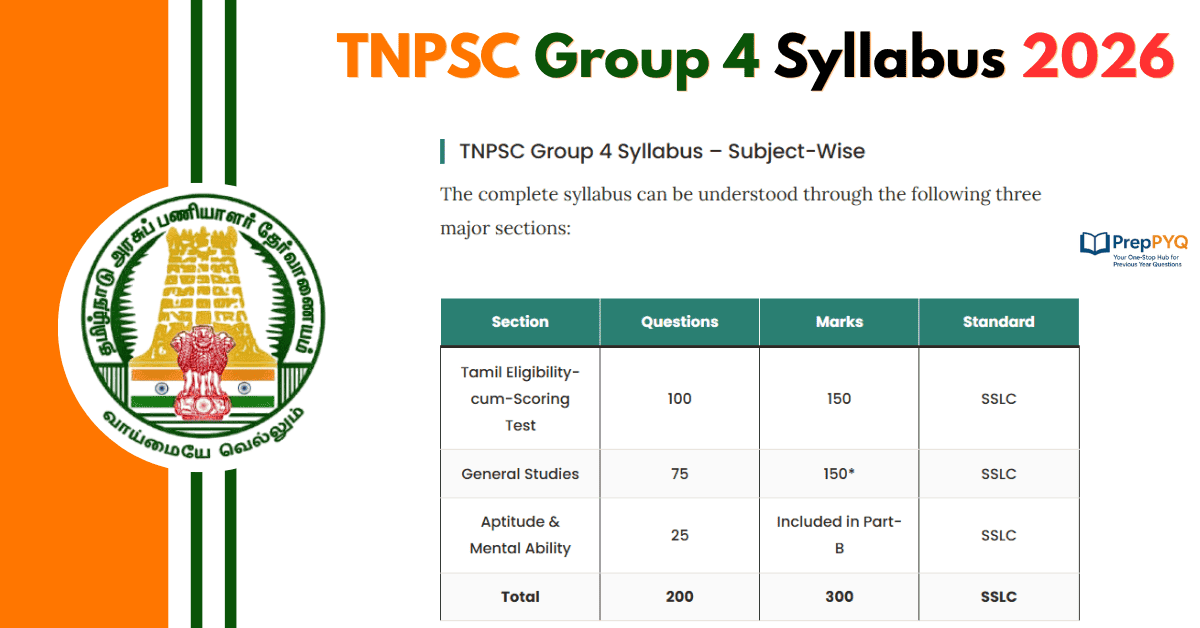
According to the official scheme, Part A contains 100 Tamil questions for 150 marks, while Part B contains 75 General Studies questions and 25 Aptitude & Mental Ability questions, also carrying 150 marks. Candidates must secure at least 60 marks in Part-A; otherwise, Part-B will not be evaluated.
TNPSC Group 4 Syllabus – Subject-Wise
The complete syllabus can be understood through the following three major sections:
| Section | Questions | Marks | Standard |
|---|---|---|---|
| Tamil Eligibility-cum-Scoring Test | 100 | 150 | SSLC |
| General Studies | 75 | 150* | SSLC |
| Aptitude & Mental Ability | 25 | Included in Part-B | SSLC |
| Total | 200 | 300 | SSLC |
General Studies and Aptitude & Mental Ability together constitute Part-B for 150 marks.
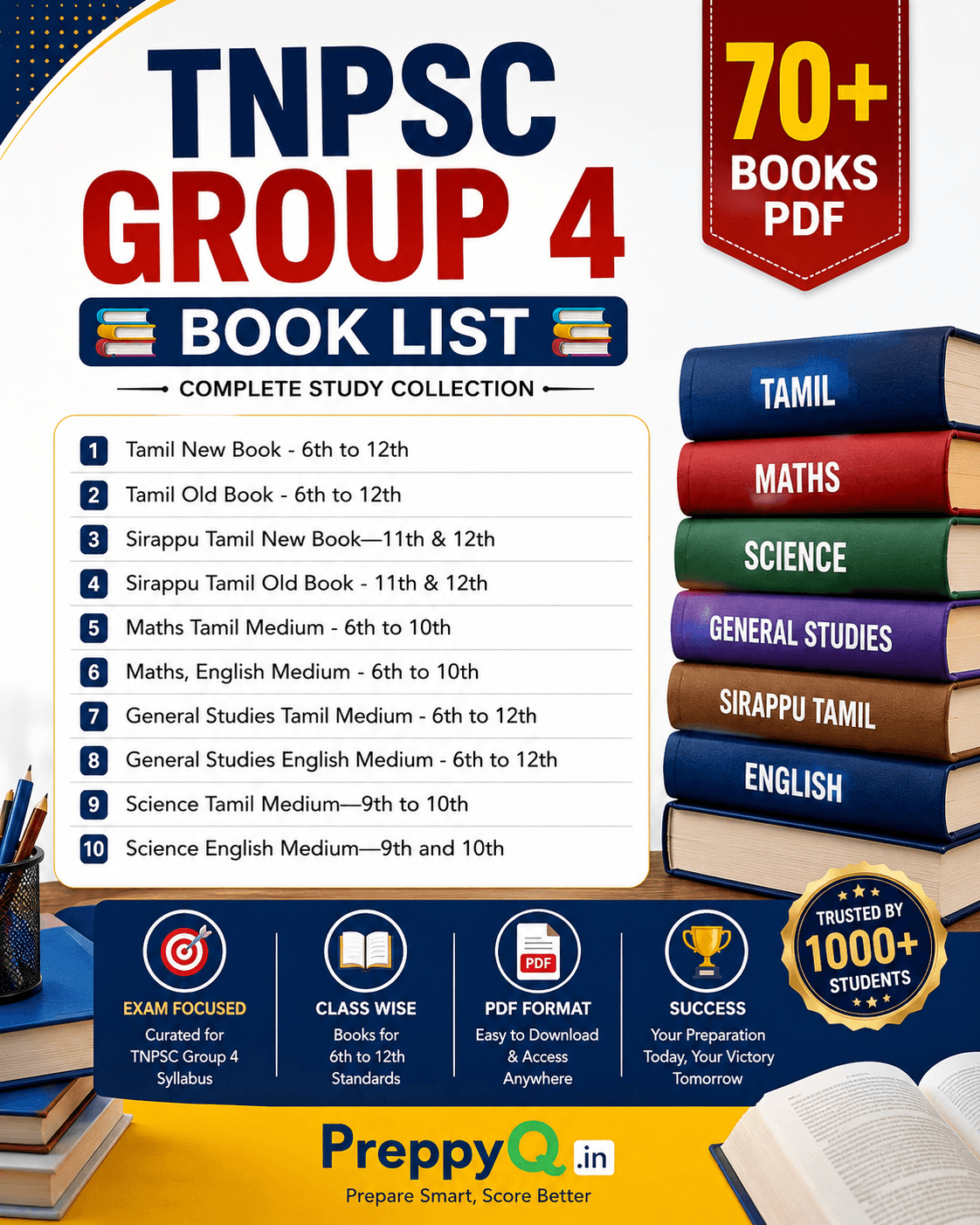
📥 TNPSC Group 4 Book List E-Book PDF Download
These books are very helpful for TNPSC Group 4 preparation. It is helpful because almost all books will be covered in the ebook PDF, and also these are suggested by the topper and official government authority, so these books are very helpful for it.
| 📚 TNPSC Group 4 Book List 📚 |
| 1. Tamil New Book- 6th to 12th |
| 2. Tamil Old Book- 6th to 12th |
| 3. Sirappu Tamil New Book—11th & 12th |
| 4. Sirappu Tamil Old Book—11th & 12th |
| 5. Maths Tamil Medium- 6th to 10th |
| 6. Maths, English Medium- 6th to 10th |
| 7. General Studies Tamil Medium: 6th to 12th |
| 8. General Studies English Medium- 6th to 12th |
| 9. Science Tamil Medium—9th to 10th |
| 10. Science English Medium—9th and 10th |
| 🗃️ Download All 70+ Book PDFs According to the syllabus: Click Here |
📚 Part A – TNPSC Group 4 Syllabus in Tamil Syllabus
The Tamil section is an important part of the examination because candidates must meet the minimum qualifying requirement in Part-A.
The official syllabus covers Tamil grammar, literature, Tamil scholars, and Tamil cultural/social contributions.
Tamil Grammar Syllabus
| Topic | Important Areas |
|---|---|
| பொருத்துதல் | Matching suitable meanings, books and authors |
| தொடரும் தொடர்பும் | Identifying references, personalities and books |
| பிரித்தெழுதுக | Separating words correctly |
| எதிர்ச்சொல் | Identifying opposite words |
| பொருந்தாச் சொல் | Finding the unsuitable word |
| பிழை திருத்தம் | Sandhi, singular/plural, traditional and foreign-word errors |
| English–Tamil Words | Identifying equivalent Tamil words |
| ஒலி வேறுபாடு | Understanding differences in pronunciation and meaning |
| ஓரெழுத்து ஒரு மொழி | Identifying one-letter words |
| வேர் சொல் | Selecting root words |
| சொல் உருவாக்கம் | Verb forms and related word formation |
| அகர வரிசை | Arranging words alphabetically |
| சொற்றொடர் | Arranging words into meaningful sentences |
| பெயர்ச்சொல் | Identifying types of nouns |
| இலக்கணக் குறிப்பு | Recognising grammatical features |
| வினா–விடை | Selecting suitable questions and answers |
| வாக்கிய வகைகள் | Identifying types of sentences |
| வினை வகைகள் | Active, causative, transitive/passive-related sentence concepts |
| உவமை | Understanding meanings expressed through similes |
| எதுகை, மோனை, இயைபு | Identifying Tamil poetic sound patterns |
| பழமொழிகள் | Understanding and applying proverbs |
These areas are based on the Tamil grammar portion specified by the Commission.
Tamil Literature Syllabus
The literature component covers important Tamil literary works and traditions.
| Area | Major Topics |
|---|---|
| Thirukkural | Selected chapters, quotations, meanings and completion of passages |
| Ethical Literature | Naladiyar, Nanmanikkadigai, Pazhamozhi Nanuru, Muthumozhikkanchi, Thirikatukam and related works |
| Kambaramayanam | Important information, poetic forms and notable lines |
| Sangam Literature | Purananuru, Akananuru, Natrinai, Kurunthogai, Ainkurunuru, Kalithogai |
| Epics | Silappathikaram, Manimekalai and other major/minor epics |
| Religious Literature | Periyapuranam, Nalayira Divya Prabandham, Thiruvilaiyadal Puranam, Thembavani, Seerapuranam |
| Minor Literature | Kuravanchi, Kalingathuparani, Muthollayiram, Tamilvidu Thoothu, Nandikkalambakam and others |
| Modern Tamil Works | Manonmaniam, Panchali Sabatham, Kuyil Pattu and related works |
| Folk Literature | Folk songs and Siddhar songs |
| Religious Leaders | Appar, Sambandar, Sundarar, Manikkavasagar, Thirumoolar, Andal and others |
The official syllabus specifically identifies these literary areas and works for preparation.
Tamil Scholars and Tamil Service
Another important component is the study of Tamil scholars, writers, social reformers, and contributors to Tamil development.
| Topic | Areas to Prepare |
|---|---|
| Tamil Poets | Bharathiyar, Bharathidasan, Namakkal Kavignar, Kavimani |
| Traditional Poetry | Mudiyarasan, Vanidasan, Suratha, Kannadasan and others |
| Modern Poetry | Important modern Tamil poets and their works |
| Tamil Letter Literature | Diaries and writings associated with important personalities |
| Folk Arts | Traditional and folk performing arts |
| Tamil Arts | Sculpture, painting, speech and cinema |
| Antiquity of Tamil | History and special characteristics of Tamil |
| Dravidian Languages | Tamil and other Dravidian languages |
| Prose Writers | Maraimalai Adigal, Mu. Varadarajan and others |
| Tamil Scholars | U.V. Swaminatha Iyer, T.P. Meenakshisundaram, C. Ilakkuvanar |
| Tamil Service | Contributions to Tamil language and literature |
| Social Reformers | Periyar, Anna, Kamarajar, Ambedkar and others |
| Tamil Women | Women achievers and their contribution to society and freedom movement |
| Tamil Trade | Archaeology, maritime trade and overseas connections |
| Food & Medicine | Traditional knowledge and medicinal plants |
| Religious Harmony | Contributions of thinkers promoting social harmony |
| Libraries | Basic information related to libraries |
TNPSC Group 4 Syllabus PDF Download
📚 Part B – TNPSC Group 4 General Studies Syllabus
General Studies contains 75 questions and is based on the SSLC standard. The official syllabus covers general science, current events, geography, history & culture of India, Indian polity, Indian economy, Indian national movement, Tamil Nadu history and culture, and development administration in Tamil Nadu.
1. General Science
| Sub-topic | Detailed Areas |
|---|---|
| Physics | Universe, physical quantities, motion, force, pressure, energy |
| Mechanics | Everyday applications of basic mechanical principles |
| Electricity | Basic concepts and everyday applications |
| Magnetism | Fundamental principles and applications |
| Light | Basic properties and applications |
| Sound | Basic concepts and applications |
| Heat | Fundamental concepts and everyday applications |
| Nuclear Physics | Basic concepts |
| Chemistry | Elements, compounds, acids, bases and salts |
| Applied Chemistry | Petroleum products, fertilizers and pesticides |
| Metallurgy | Basic concepts |
| Food Science | Food adulteration |
| Biology | Classification of organisms, evolution and genetics |
| Human Biology | Physiology, nutrition, health and hygiene |
| Diseases | Common human diseases |
| Environment | Environmental science |
2. Current Events
| Area | What to Study |
|---|---|
| National Events | Major developments in India |
| State Events | Important Tamil Nadu developments |
| National Symbols | Important national symbols |
| States | Profiles and important facts |
| Personalities | Eminent personalities in the news |
| Places | Important places appearing in current affairs |
| Sports | Major tournaments, players and achievements |
| Books | Important books and authors |
| Government Schemes | Major welfare schemes |
| Politics | Political parties and political systems |
| Science & Technology | Recent inventions and developments |
| Geography | Important geographical developments |
| Socio-Economic Issues | Current social and economic issues |
Preparation tip: For current affairs, focus particularly on important events involving Tamil Nadu and India.
3. Geography
| Topic | Detailed Areas |
|---|---|
| Earth | Location and basic geographical features |
| Physical Features | Major physical divisions |
| Climate | Monsoon, rainfall, weather and climate |
| Water Resources | Rivers and water resources |
| Soil | Major soil resources |
| Minerals | Mineral and natural resources |
| Forests | Forest resources and wildlife |
| Agriculture | Agricultural patterns |
| Transport | Major transportation systems |
| Communication | Communication networks |
| Population | Population density and distribution |
| Tamil Nadu Geography | Population and geographical characteristics of Tamil Nadu |
| Disaster Management | Natural calamities and disaster management |
| Environment | Environmental issues |
| Climate Change | Basic concepts and impacts |
4. History and Culture of India
| Topic | Important Areas |
|---|---|
| Ancient India | Indus Valley Civilization |
| Medieval India | Guptas, Delhi Sultanate, Mughals and Marathas |
| South India | Important aspects of South Indian history |
| Indian Culture | Characteristics of Indian culture |
| Unity in Diversity | Race, language and customs |
| Secularism | India as a secular state |
5. Indian Polity
| Topic | Detailed Areas |
|---|---|
| Constitution | Constitution of India |
| Preamble | Features and significance |
| Constitutional Features | Salient features |
| Union & States | Union, States and Union Territories |
| Citizenship | Constitutional provisions |
| Fundamental Rights | Major rights |
| Fundamental Duties | Duties of citizens |
| DPSP | Directive Principles of State Policy |
| Union Executive | President, Vice-President, Prime Minister and Council of Ministers |
| Parliament | Lok Sabha, Rajya Sabha and legislative process |
| State Executive | Governor, Chief Minister and Council of Ministers |
| State Legislature | State legislative institutions |
| Local Government | Local bodies |
| Panchayati Raj | Rural local governance |
| Federalism | Centre-State relations |
| Elections | Election system |
| Judiciary | Indian judicial system |
| Rule of Law | Basic principles |
| Anti-Corruption | Anti-corruption mechanisms |
| Lokpal & Lokayukta | Institutions and functions |
| RTI | Right to Information |
| Women Empowerment | Constitutional and social dimensions |
| Consumer Protection | Consumer protection mechanisms |
| Human Rights | Human rights framework |
6. Indian Economy
| Topic | Detailed Areas |
|---|---|
| Indian Economy | Nature and characteristics |
| Planning | Five-Year Plan models and assessment |
| Institutions | Planning Commission and NITI Aayog |
| Revenue | Major sources of government revenue |
| RBI | Role of Reserve Bank of India |
| Finance Commission | Functions and significance |
| Centre-State Finance | Resource sharing |
| GST | Goods and Services Tax |
| Employment | Employment generation |
| Agriculture | Agriculture and land reforms |
| Technology | Science and technology in agriculture |
| Industry | Industrial growth |
| Rural Development | Rural welfare programmes |
| Social Problems | Population, education and health |
| Poverty | Poverty and related issues |
7. Indian National Movement
| Topic | Areas to Prepare |
|---|---|
| National Renaissance | Growth of national consciousness |
| Early Resistance | Early uprisings against British rule |
| Indian National Congress | Formation and development |
| National Leaders | Major leaders and their contributions |
| B.R. Ambedkar | Contribution to social and national development |
| Bhagat Singh | Role in the freedom movement |
| Bharathiyar | Contribution to nationalism |
| V.O. Chidambaranar | Role in the freedom struggle |
| Periyar | Social reform and political movements |
| Gandhi | Leadership of the national movement |
| Nehru | Role in the freedom struggle |
| Rajaji | Contribution to national movement |
| Subhas Chandra Bose | National movement and INA |
| Kamarajar | Political and social contributions |
| Women Leaders | Contributions of women to the freedom movement |
| Tamil Nadu Movements | Various stages and movements in Tamil Nadu |
8. History, Culture, Heritage and Socio-Political Movements of Tamil Nadu
This section is particularly important for candidates preparing for TNPSC examinations.
| Topic | Detailed Areas |
|---|---|
| Tamil Society | History and development |
| Archaeology | Archaeological discoveries connected with Tamil society |
| Tamil Literature | Sangam period to contemporary literature |
| Thirukkural | Secular character and relevance |
| Human Values | Equality, humanism and universal values |
| Social Issues | Relevance of Thirukkural to social affairs |
| Political Affairs | Relevance of Thirukkural to political life |
| Economic Affairs | Relevance of Thirukkural to economic affairs |
| Tamil Nadu Freedom Struggle | Role of Tamil Nadu |
| Women in Freedom Movement | Contribution of women |
| Social Reformers | Major reformers |
| Social Reform Movements | Important movements |
| Social Transformation | Changes brought by reform movements |
9. Development Administration in Tamil Nadu
| Topic | What to Study |
|---|---|
| Social Justice | Social justice as a foundation of development |
| Social Harmony | Importance of social harmony |
| Education | Education system in Tamil Nadu |
| Health | Health system in Tamil Nadu |
| Tamil Nadu Geography | Geographical characteristics |
| Economic Development | Impact of geography on economic growth |
Part B – Aptitude & Mental Ability Syllabus
The Aptitude and Mental Ability section contains 25 questions. The official syllabus includes numerical aptitude as well as reasoning and mental ability topics.
| Topic | Important Areas |
|---|---|
| Simplification | Basic numerical simplification |
| Percentage | Percentage calculations and applications |
| HCF | Highest Common Factor |
| LCM | Lowest Common Multiple |
| Ratio | Ratio-based problems |
| Proportion | Proportion-based problems |
| Simple Interest | SI calculations |
| Compound Interest | CI calculations |
| Area | Basic area problems |
| Volume | Basic volume problems |
| Time & Work | Work and efficiency problems |
| Logical Reasoning | Logical thinking questions |
| Puzzles | Basic puzzle-based reasoning |
| Dice | Dice-related problems |
| Visual Reasoning | Visual pattern questions |
| Alpha-Numeric Reasoning | Letter-number relationships |
| Number Series | Number patterns and sequences |
Also Check Out: TNPSC Group 4 Syllabus PDF Download
📥 Best Book For TNPSC Group 4 and PYQs [E-Book]
10 Years’ TNPSC Question Papers
TNPSC Group 4 Book 70+ PDF
TNPSC 2026 to 2012 GS Quest 169 Set
TNPSC 2025 to 2012 General English
TNPSC 2025 to 2012 General Tamil 37 Sets

TH Newspaper Paid One-Time Membership
Frequently Asked Questions – TNPSC Group 4 Syllabus PDF Download
1. What is the TNPSC Group 4 syllabus?
The TNPSC Group 4 syllabus covers Tamil Eligibility-cum-Scoring, General Studies, and Aptitude & Mental Ability. The examination is based on the SSLC standard.
2. How many questions are asked in TNPSC Group 4?
The examination consists of 200 objective-type questions.
3. How many marks is the TNPSC Group 4 examination?
The maximum mark is 300.
4. What is the duration of the TNPSC Group 4 exam?
The examination duration is 3 hours.
5. Is Tamil compulsory in TNPSC Group 4?
Yes. The current scheme includes the Tamil Eligibility-cum-Scoring Test as Part-A. Candidates must obtain the prescribed minimum marks in this section.
6. What is the standard of the TNPSC Group 4 syllabus?
The official syllabus is based on the SSLC standard.
Conclusion
The TNPSC Group 4 syllabus provides a clear roadmap for candidates preparing for the Tamil Nadu government recruitment examination. The paper consists of 200 questions for 300 marks, with Tamil forming Part A and General Studies along with Aptitude & Mental Ability forming Part B.
For effective preparation, candidates should combine the official syllabus with TNPSC Group 4 previous year question papers, mock tests, revision notes, and regular practice. Rather than studying every available topic, follow the syllabus systematically and revise each section multiple times.
For the most reliable TNPSC Group 4 Syllabus PDF Download, always give preference to the latest document published by the Tamil Nadu Public Service Commission.
TNPSC Group 4 Syllabus PDF Download 2026 / TNPSC Group 4 Syllabus PDF Download new pattern / TNPSC Group 4 Syllabus PDF Download 2026 Download/TNPSC Group 4 Syllabus PDF Download detailed syllabus analysis / TNPSC Group 4 Syllabus PDF Download/TNPSC Group 4 Syllabus PDF Download/TNPSC Group 4 Syllabus PDF Download 2026

Founder of PreppyQ.in | Education Entrepreneur | SEO Content Creator
Passionate about helping students achieve their academic and career goals through quality educational resources. Founder of PreppyQ.in, a platform dedicated to providing Previous Year Question Papers, Mock Tests, Study Materials, and Exam Preparation Resources for UPSC, SSC, Banking, Railway, Teaching, and other competitive examinations. Focused on building accessible and student-friendly learning solutions while leveraging SEO and digital innovation to reach millions of learners across India.
1 thought on “TNPSC Group 4 Syllabus PDF Download Free 2026 – Latest Exam Pattern & Detailed Syllabus”