Biotechnology Principles and Processes NEET PYQ (200+ Questions Free PDF Download)
The Biotechnology Principles and Processes NEET PYQ chapter is one of the most important and scoring topics in NEET Biology. Every year, NEET includes direct questions from NCERT lines, diagrams, and concepts such as genetic engineering, recombinant DNA technology, PCR, and gel electrophoresis.

If you want to score high in NEET 2026, practicing previous year questions (PYQs) from this chapter is extremely important. PYQs help you understand the exam pattern, frequently asked concepts, and important for Biotechnology Principles and Processes NEET PYQ MCQs.

Biotechnology Principles and Processes NEET PYQ Overview

Biotechnology is the use of living organisms or biological systems to develop useful products for humans.

📌 The chapter is divided into two parts:

Principles of Biotechnology

  • Genetic engineering basics
  • Recombinant DNA technology
  • Enzymes like restriction enzymes and ligase
  • Vectors and host cells

Processes of Biotechnology

  • PCR (Polymerase Chain Reaction)
  • Gel electrophoresis
  • Gene cloning
  • DNA manipulation steps

Biotechnology Principles and Processes NEET PYQ [2024-2013]

Comprehensive NEET Mock Test – Biotechnology: Principles and Processes

Biotechnology Principles and Processes NEET PYQ

Preppyq.in

Comprehensive Practice Guidelines:
  • This comprehensive mock test contains all 72 unique multiple-choice questions sorted meticulously section-by-section.
  • Select the correct choices directly on the interface.
  • Scroll to the absolute bottom and click “Submit and Score Test” to access real-time status feedback and answer analysis keys.

Section 1: Principles of Biotechnology (Q1 – Q5)

1. In a chromosome, there is a specific DNA sequence, responsible for initiating replication. It is called as:
Correct Answer: d. ‘ori site’ (Origin of Replication) is the essential sequence where replication is initialized.
2. What is the fate of a piece of DNA carrying a gene of interest which is transferred into an alien organism?
A. The piece of DNA would be able to multiply, itself independently in the progeny cells of the organism.
B. It may get integrated into the genome of recipient.
C. It may multiply and be inherited along with the host DNA.
D. The alien piece of DNA is not an integral part of chromosome.
E. It shows ability to replicate.
Choose the correct answer from the options given below:
Correct Answer: a. Statements B and C are correct because unless integrated into the host’s chromosome, an alien piece of DNA cannot replicate independently.
3. Pathogenic bacteria gain resistance to antibiotics due to changes in their:
Correct Answer: c. Plasmids contain extra-chromosomal genes like resistance genes that grant antibiotic defense.
4. Which of the following methods is not commonly used for introducing foreign DNA into the plant cell?
Correct Answer: a. Bacteriophages naturally infect bacteria, not plant hosts.
5. The cutting of DNA at specific locations became possible with the discovery of:
Correct Answer: d. Restriction endonucleases function as molecular scissors to slice DNA at specific target intervals.

Section 2: Tools of Recombinant DNA Technology (Q6 – Q44)

6. Identify the incorrect statement related to gel electrophoresis.
Correct Answer: a. DNA fragments cannot be viewed directly under UV unless they are stained with a fluorescent compound like Ethidium Bromide first.
7. Recombinant DNA molecule can be created normally by cutting the vector DNA and source DNA respectively with:
Correct Answer: a. Both target structures must be cut by the same restriction endonuclease enzyme to generate matching sticky/blunt ends.
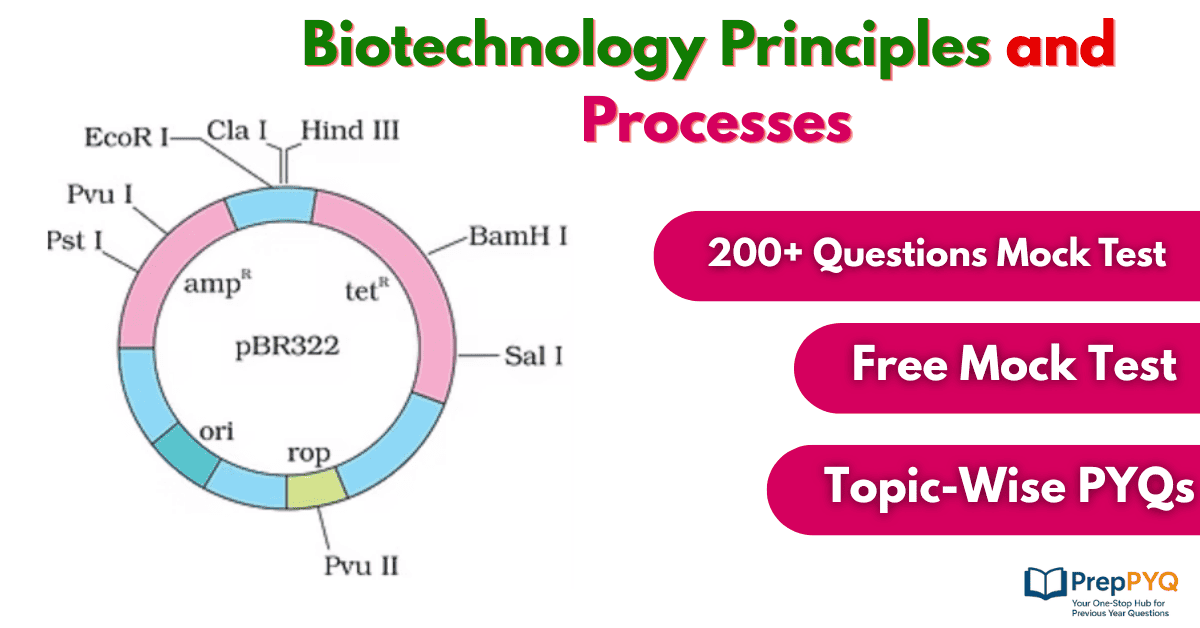
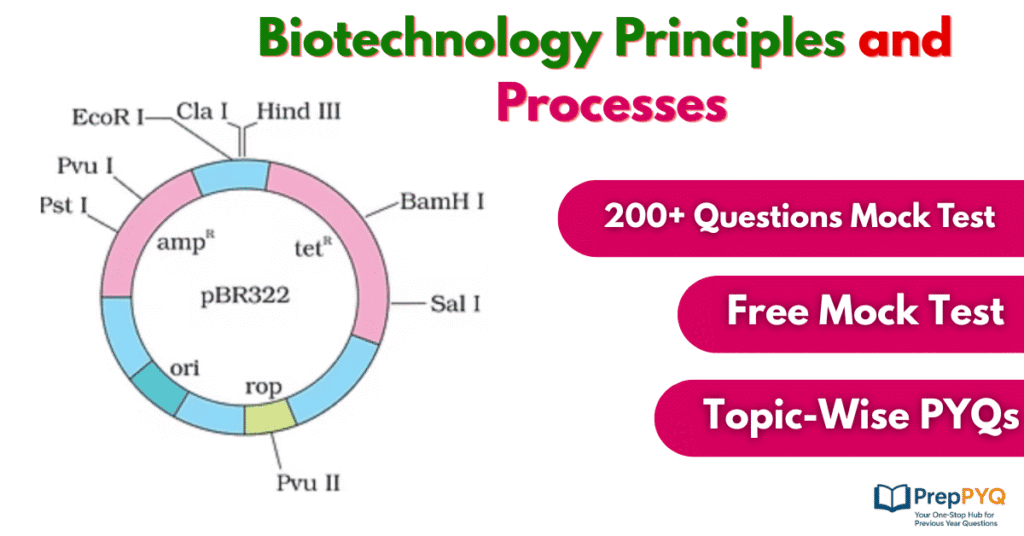
8. Select the restriction endonuclease enzymes whose restriction sites are present for the tetracycline resistance (tet) gene in the pBR322 cloning vector.
Correct Answer: a. BamHI and SalI have restriction sites directly inside the tetracycline resistance region of pBR322.
9. Which of the following are correct about EcoRI?
A. Cut the DNA with blunt end
B. Cut the DNA with sticky end
C. Recognises a specific palindromic sequence
D. Cut the DNA between the base G and A when encounters the DNA sequence ‘GAATTC’
E. Exonuclease
Choose the correct answer from the options given below:
Correct Answer: d. EcoRI is an endonuclease that creates overhanging sticky ends by cutting between G and A in the 5′-GAATTC-3′ palindrome.
10. Hind II always cuts DNA molecules at a particular point called recognition sequence and it consists of:
Correct Answer: d. Hind II is specific to a 6 base-pair structural alignment layout.
11. The diagram showing restriction sites in E. coli cloning vector pBR322. Find the role of ‘X’ and ‘Y’ genes (where X points to ‘ori’ and Y points to ‘rop’):
Correct Answer: d. ‘X’ is the origin of replication (ori), which regulates copy number, and ‘Y’ is rop, which translates copy control structural factors.
12. The “Ti plasmid” of Agrobacterium tumefaciens stands for:
Correct Answer: a. Tumor inducing plasmid. It transforms normal plant tissue cells into crown gall tumors.
13. Upon exposure to UV radiation, DNA stained with ethidium bromide will show:
Correct Answer: a. Ethidium bromide intercalates with DNA to reflect vivid fluorescent bright orange bands under ultraviolet exposures.
14. In gene gun method used to introduce alien DNA into host cells, microparticles of _________ metal are used.
Correct Answer: d. High-density inert microparticles composed of tungsten or gold carry target DNA coats.
15. Which of the following is not a cloning vector?
Correct Answer: a. A probe is a single-stranded labeled nucleic acid segment utilized to spot sequence complements, not a vehicle designed for vector propagation.
16. Ligation of foreign DNA at which of the following site will result in loss of tetracycline resistance of pBR322:
Correct Answer: d. Slicing at the BamHI terminal splits the tetracycline-resistance open frame, inducing insertional inactivation.
17. Match List-I with List-II.
List-I: (A) Kanamycin, (B) ClaI, (C) Disarmed retroviruses, (D) Kanamycin gene
List-II: (I) Delivers genes into animal cells, (II) Selectable marker, (III) Restriction site, (IV) Antibiotic resistance
Choose the correct answer from options:
Correct Answer: c. Kanamycin is an antibiotic that tests resistance (IV). ClaI is a restriction site (III). Disarmed retroviruses deliver animal genes (I). The Kanamycin gene serves as a selectable marker (II).
18. Which of the following can act as molecular scissors?
Correct Answer: a. Restriction endonucleases cleave backbone internal steps, functioning as biological cutters.
19. Assertion (A): When a particular restriction enzyme cuts strand of DNA, overhanging stretches or sticky ends are formed.
Reason (R): Some restriction enzymes cut the strand of DNA a little away from the centre of the palindromic site.
Choose the correct option:
Correct Answer: b. Slicing in staggered layouts slightly away from the center but between matching single base frames creates sticky overhanging steps.
20. Separation of DNA fragments is done by a technique known as:
Correct Answer: a. Gel electrophoresis divides a sample of fragments by driving them through an electric matrix based on length.
21. In the following palindromic base sequences of DNA, which one can be cut easily by particular restriction enzyme?
Correct Answer: c. The sequence 5′-GAATTC-3′ paired with 3′-CTTAAG-5′ forms the perfect standard palindrome recognized by EcoRI.
22. Which of the following is not a desirable feature of a cloning vector?
Correct Answer: a. Multiple recognition sites for a single enzyme complicate cloning by splitting the vector into several fragments.
23. Statement I: Restriction endonucleases recognise specific sequence to cut DNA known as palindromic nucleotide sequence.
Statement II: Restriction endonucleases cut the DNA strand a little away from the centre of the palindromic site.
Choose the correct option:
Correct Answer: b. Both statements are accurate regarding the action mechanism of restriction endonucleases.
24. DNA strands on a gel stained with ethidium bromide when viewed under UV radiation, appear as:
Correct Answer: a. They show up as distinct fluorescent bright orange bands.
25. Plasmid pBR322 has PstI restriction enzyme site within gene amp that confers ampicillin resistance. If this enzyme is used for inserting a gene for beta-galactoside production and the recombinant plasmid is inserted in an E.coli strain:
Correct Answer: d. Inserting foreign DNA within the ampicillin gene deactivates it, making the transformants sensitive to ampicillin.
26. A specific recognition sequence identified by endonucleases to make cuts at specific positions within the DNA is:
Correct Answer: b. Restriction endonucleases recognize specific palindromic nucleotide sequences to introduce cuts.
27. First discovered restriction endonuclease that always cuts DNA molecule at a particular point by recognising a specific sequence of six base pairs is:
Correct Answer: c. Hind II was the first isolated restriction enzyme that recognized a specific 6 base pair sequence.
28. Match the organism with its use in biotechnology:
1. Bacillus thuringiensis, 2. Thermus aquaticus, 3. Agrobacterium tumifaciens, 4. Salmonella typhimurium
(i) Cloning vector, (ii) Construction of first rDNA, (iii) DNA polymerase, (iv) Cry proteins
Correct Answer: a. B. thuringiensis codes for Cry proteins. T. aquaticus provides Taq polymerase. Agrobacterium acts as a plant vector, and S. typhimurium was used in the first rDNA experiment.
29. The sequence that controls the copy number of the linked DNA in the vector, is termed:
Correct Answer: a. The ‘ori’ site controls the duplication frequency of the plasmid vector inside host strains.
30. The specific palindromic sequence which is recognized by EcoRI is:
Correct Answer: d. EcoRI targets 5′-GAATTC-3′ on one strand and 3′-CTTAAG-5′ on the complementary strand.
31. Identify the wrong statement with regard to restriction enzymes.
Correct Answer: d. Restriction enzymes inspect the total sequence to locate a specific short sequence, not to evaluate total macro length.
32. Choose the correct pair from the following:
Correct Answer: d. Ligases are specialized molecular glues that form phosphodiester links between DNA segments.
33. Following statements describe the characteristics of the enzyme restriction endonuclease. Identify the incorrect statement.
Correct Answer: b. The enzyme cuts both backbones of a double-stranded helix at specific sites, not just one.
34. A gene whose expression helps to identify transformed cell is known as:
Correct Answer: a. Selectable markers differentiate non-transformed cells from transformed host cells.
35. Restriction endonucleases are:
Correct Answer: c. Bacteria make restriction enzymes to cut up foreign bacteriophage DNA as a defense mechanism.
36. Which of the following restriction enzymes produces blunt ends?
Correct Answer: d. EcoRV cuts both DNA strands at the same central position, creating clean blunt ends.
37. A foreign DNA and plasmid cut by the same restriction endonuclease can be joined to form a recombinant plasmid using:
Correct Answer: b. DNA ligase covalently seals matching fragments into a single piece.
38. Which of the following is a restriction endonuclease?
Correct Answer: a. Hind II is a restriction endonuclease enzyme; others are standard non-specific digestive enzymes.
39. Which of the following is not a feature of the plasmids?
Correct Answer: d. Plasmids are double-stranded circular DNA loops.
40. The DNA molecule to which the gene of interest is integrated for cloning is called:
Correct Answer: a. A vector acts as a vehicle to transport foreign genetic material into another cell for cloning.
41. The introduction of t-DNA into plants involves:
Correct Answer: d. Agrobacterium tumefaciens naturally infects plant wounds to transfer its T-DNA region.
42. Which vector can clone only a small fragment of DNA?
Correct Answer: d. Plasmids typically clone smaller inserts (usually under 10 kb) compared to larger vectors like cosmids, BACs, or YACs.
43. DNA fragments generated by the restriction endonuclease in a chemical reaction can be separated by:
Correct Answer: d. Agarose gel electrophoresis separates DNA pieces based on molecular size.
44. The colonies of recombinant bacteria appear white in contrast to blue colonies of non-recombinant bacteria because of:
Correct Answer: d. Recombinants break the beta-galactosidase gene sequence (insertional inactivation), preventing them from turning blue on an X-gal substrate.

Section 3: Processes of Recombinant DNA Technology (Q45 – Q72)

45. Following are the steps involved in the process of PCR.
A. Annealing, B. Amplification (~1 billion times), C. Denaturation, D. Treatment with Taq polymerase and deoxynucleotides, E. Extension
Choose the correct sequence of steps:
Correct Answer: a. The correct order is Denaturation (C), Annealing (A), addition of Taq polymerases/dNTPs (D) for Extension (E), resulting in overall Amplification (B).
46. Which of the following statements is incorrect?
Correct Answer: a. Bioreactors are designed for large-scale industrial volumes (100–1000 liters), not small-scale lab setups.
47. During the purification process for recombinant DNA technology, addition of chilled ethanol precipitates out:
Correct Answer: c. Adding chilled ethanol precipitates purified DNA out of solution as white threads.
48. Main steps in the formation of Recombinant DNA are given below. Arrange these steps in a correct sequence:
A. Insertion of recombinant DNA into the host cell.
B. Cutting of DNA at specific location by restriction enzyme.
C. Isolation of desired DNA fragment.
D. Amplification of gene of interest using PCR.
Correct Answer: b. The correct process order is cutting DNA (B), isolating the fragment (C), amplifying it via PCR (D), and inserting it into the host (A).
49. Thermostable DNA polymerase used in PCR was isolated from:
Correct Answer: a. Taq polymerase is extracted from the thermophilic bacterium Thermus aquaticus.
50. The enzyme (a) is needed for isolating genetic material from plant cells and enzyme (b) for isolating genetic material from fungus. Choose the correct pair:
Correct Answer: c. Cellulase breaks down plant cellulose walls, while chitinase degrades fungal chitin walls.
51. Refer to the following statements for agarose gel electrophoresis:
A. Agarose is a natural polymer obtained from sea-weed.
B. The separation of DNA molecules in agarose-gel electrophoresis depends on the size of DNA.
C. The DNA migrates from negatively-charged electrode to the positively-charged electrode
D. The DNA migrates from positively-charged electrode to the negatively-charged electrode.
Choose the most appropriate answer:
Correct Answer: c. Statements A, B, and C are correct. Statement D is false because DNA has a negative charge and moves toward the positive electrode (anode).
52. Which one of the following statement is not true regarding gel electrophoresis technique?
Correct Answer: d. Chromogenic substrates are used in bacterial colony selection, not to stain DNA bands during gel electrophoresis.
53. Given below are two statements: one is labelled as Assertion (A) and the other is labelled as Reason (R).
Assertion (A): Polymerase chain reaction is used in DNA amplification
Reason (R): The ampicillin resistant gene is used as a selectable marker to check transformation
Choose the correct answer:
Correct Answer: c. Both statements are factually true, but the role of selectable markers in transformation is unrelated to the biochemical mechanism of PCR amplification.
54. During the purification process for recombinant DNA technology, addition of chilled ethanol precipitates out:
Correct Answer: a. Chilled ethanol lowers the solubility of DNA, causing it to precipitate out of the mixture.
55. During the process of gene amplification using PCR, if very high temperature is not maintained in the beginning, then which of the following steps of PCR will be affected first?
Correct Answer: b. High temperatures (around 94°C) are required to denature and separate the double-stranded DNA template.
56. In gel electrophoresis, separated DNA fragments can be visualized with the help of:
Correct Answer: a. Staining with ethidium bromide makes DNA fragments fluoresce under UV radiation.
57. In a mixture, DNA fragments are separated by:
Correct Answer: b. Gel electrophoresis separates mixed DNA fragments by pulling them through a porous matrix using an electric current.
58. In recombinant DNA technology antibiotics are used:
Correct Answer: c. Antibiotic resistance genes serve as selectable markers to identify transformed cells.
59. Match the following techniques or instruments with their usage:
1. Bioreactor, 2. Electrophoresis, 3. PCR, 4. ELISA
(i) Separation of DNA fragments, (ii) Production of large quantities, (iii) Antigen-antibody reaction detection, (iv) Amplification of nucleic acids
Correct Answer: a. Bioreactors scale up production (ii). Electrophoresis separates fragments (i). PCR amplifies DNA (iv), and ELISA tracks antigen-antibody binding (iii).
60. Spooling is:
Correct Answer: c. Spooling is the technique of winding precipitated DNA threads onto a glass rod.
61. Select the correct statement from the following:
Correct Answer: b. Restriction digests require incubating purified DNA with the target enzyme under optimized temperature and buffer conditions.
62. Which one of the following equipments is essentially required for growing microbes on a large scale, for industrial production of enzymes?
Correct Answer: d. Bioreactors maintain optimal conditions for large-scale industrial microbial growth.
63. DNA precipitation out of a mixture of biomolecules can be achieved by treatment with:
Correct Answer: b. Chilled ethanol precipitates purified DNA out of solution.
64. The correct order of steps in Polymerase Chain Reaction (PCR) is:
Correct Answer: d. Each PCR cycle follows the sequence: Denaturation, Annealing, and then Extension.
65. What is the criterion for DNA fragments movement on agarose gel during gel electrophoresis?
Correct Answer: b. Smaller DNA fragments move faster and farther through the pores of the agarose gel matrix.
66. The process of separation and purification of expressed protein before marketing is called:
Correct Answer: b. Downstream processing covers the post-harvest separation, isolation, and purification of products.
67. The DNA fragments separated on an agarose gel can be visualised after staining with:
Correct Answer: d. Ethidium bromide intercalates with DNA to make bands visible under UV transillumination.
68. Which of the following is not a component of downstream processing?
Correct Answer: b. Protein expression is an upstream metabolic production phase, not a downstream processing step.
69. Stirred-tank bioreactors have been designed for:
Correct Answer: a. The stirrer continuously mixes the culture to ensure even oxygen distribution throughout the bioreactor.
70. The Taq polymerase enzyme is obtained from:
Correct Answer: a. Taq polymerase is isolated from the heat-tolerant bacterium Thermus aquaticus.
71. In vitro clonal propagation in plants is characterised by:
Correct Answer: b. PCR and RAPD assays are used to verify genetic uniformity and screen profiles in plant tissue cultures.
72. Which of the following is not correctly matched for the organism and its cell wall degrading enzyme?
Correct Answer: d. Algae do not use methylase to digest cell walls. Algal walls are typically broken down by cellulase-based enzyme mixes.
NEET Last 10 Years Previous Year Question Paper
Last 10 Years NEET Previous Year Question Paper

❓ FAQs – Biotechnology Principles and Processes NEET PYQ

Biotechnology Principles and Processes NEET PYQ

❓ What is Biotechnology Principles and Processes in NEET?

Biotechnology Principles and Processes is a Class 12 Biology chapter that explains genetic engineering, recombinant DNA technology, enzymes, and lab techniques like PCR and gel electrophoresis.

❓ Why are biotechnology principles and processes NEET PYQ important?

NEET PYQs help students understand repeated questions, exam patterns, and important NCERT-based concepts, making this chapter easier to score.

❓ How many questions come from Biotechnology Principles and Processes NEET PYQ?

Generally, NEET includes 1 to 3 questions every year from this chapter, mostly directly from NCERT lines.

❓ Are biotechnology principles and processes NEET PYQ preparation?

PYQs are very helpful, but they should be combined with NCERT reading and MCQ practice for full preparation.

❓ What are the most important topics in Biotechnology Principles and Processes for NEET?

Important topics include restriction enzymes, recombinant DNA technology, PCR, gel electrophoresis, vectors, and host cells.

The Biotechnology Principles and Processes NEET PYQ, Biotechnology Principles and Processes NEET PYQ , Biotechnology Principles and Processes NEET PYQ , Biotechnology Principles and Processes NEET PYQ , Biotechnology Principles and Processes NEET PYQ , chapter is one of the most scoring and important topics in NEET Biology. With proper practice of MCQs, revision of NCERT, and solving previous year questions, students can easily secure full marks from this chapter. Biotechnology Principles and Processes NEET PYQ , Biotechnology Principles and Processes NEET PYQ , Biotechnology Principles and Processes NEET PYQ Online, Biotechnology Principles and Processes NEET PYQ practice, Biotechnology Principles and Processes NEET PYQ all pyq in these topics, Biotechnology Principles and Processes NEET PYQ

Leave a Comment