UPSC Political Science and International Relations (PSIR) is one of the most popular optional subjects chosen by civil services aspirants. Candidates who aim to secure high marks in the UPSC Mains examination candidates should regularly practice UPSC Political Science Optional Solved Question Papers. These solved papers provide a clear understanding of the examination pattern, answer-writing techniques, important topics, and the level of analytical thinking required by the Union Public Service Commission (UPSC).
In recent years, Political Science Optional has emerged as a scoring subject due to its overlap with general studies papers, essays, and interview preparation. Solving previous year question papers helps candidates identify recurring themes and prepare their answers according to UPSC standards.
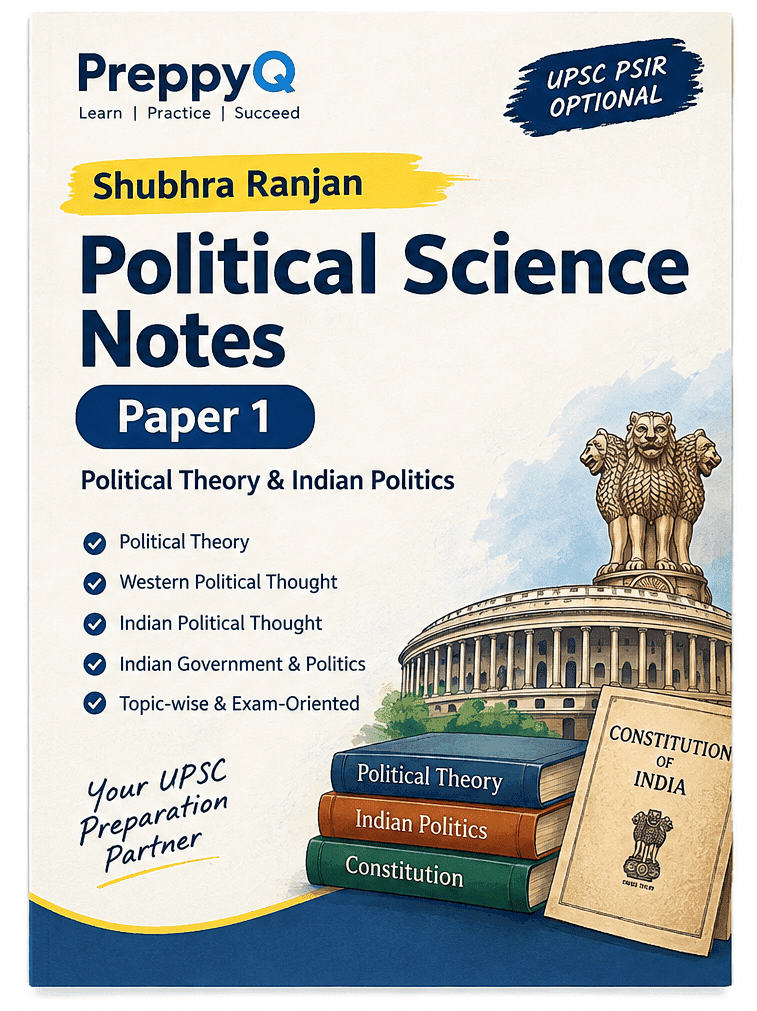
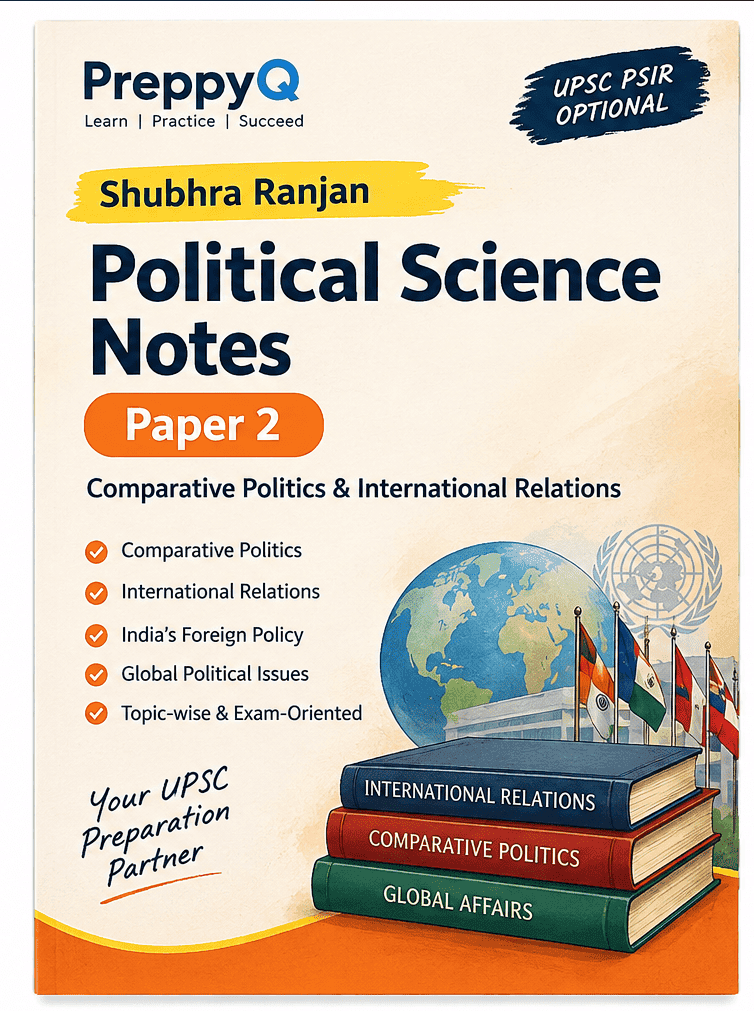
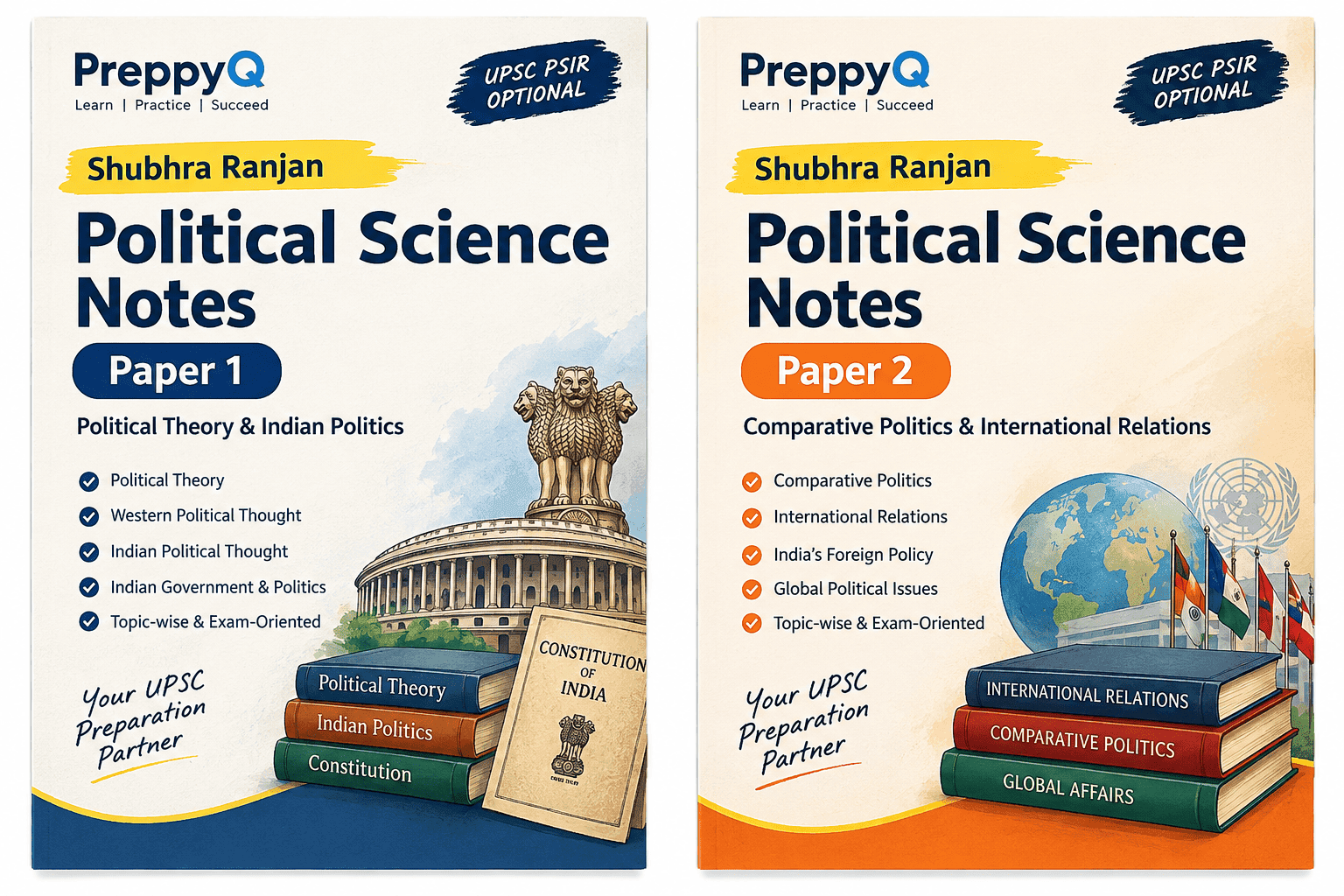
Shubhra Ranjan, Political Science Notes Paper 1 & 2 Latest Updated Notes PDF: Download
📘 UPSC Political Science Optional Exam Pattern
Political Science Optional consists of two papers:
📝 Paper I: Political Theory and Indian Politics
Topics include:
- Political Theory
- Western Political Thought
- Indian Political Thought
- Comparative Politics
- Indian Government and Politics
📝 Paper II: International Relations
Topics include:
- Comparative Political Analysis
- International Politics
- India’s Foreign Policy
- International Organizations
- Global Political Issues
- India and the World
Each paper carries 250 marks, making a total of 500 marks in the UPSC Mains examination.
📘 UPSC Political Science Optional Solved Question Papers and PSIR Question
📥UPSC Political Science Optional Solved Question Papers 2025
| PSIR 2025 Question Paper | PDF Download |
| UPSC PSIR Optional Paper-I | Download |
| UPSC PSIR Optional Paper-II | Download |
📥 UPSC Political Science Optional Solved Question Papers 2024
| PSIR 2024 Question Paper | PDF Download |
| UPSC PSIR Optional Paper-I | Download |
| UPSC PSIR Optional Paper-II | Download |
📥 UPSC Political Science Optional Solved Question Papers 2023
| PSIR 2023 Question Paper | PDF Download |
| UPSC PSIR Optional Paper-I | Download |
| UPSC PSIR Optional Paper-II | Download |
📥 UPSC Political Science Optional Solved Question Papers 2022
| PSIR 2022 Question Paper | PDF Download |
| UPSC PSIR Optional Paper-I | Download |
| UPSC PSIR Optional Paper-II | Download |
📥 UPSC Political Science Optional Solved Question Papers 2021
| PSIR 2021 Question Paper | PDF Download |
| UPSC PSIR Optional Paper-I | Download |
| UPSC PSIR Optional Paper-II | Download |
📥 UPSC PSIR Optional Question Paper 2020
| PSIR 2020 Question Paper | PDF Download |
| UPSC PSIR Optional Paper-I | Download |
| UPSC PSIR Optional Paper-II | Download |
📥 UPSC political Science Optional Question Paper 2019
| PSIR 2019 Question Paper | PDF Download |
| UPSC PSIR Optional Paper-I | Download |
| UPSC PSIR Optional Paper-II | Download |
📥 UPSC political Science Optional Question Paper 2018
| PSIR 2018 Question Paper | PDF Download |
| UPSC PSIR Optional Paper-I | Download |
| UPSC PSIR Optional Paper-II | Download |
Also Check Out
📘 UPSC Political Science & International Relations (PSIR) Optional Syllabus
PSIR Optional Structure
| Paper | Section | Marks |
|---|---|---|
| Paper-I | Political Theory & Indian Politics | 250 |
| Paper-II | Comparative Politics & International Relations | 250 |
| Total | Optional Subject | 500 |
Paper-I: Political Theory and Indian Politics
| Unit | Topics |
|---|---|
| 1. Political Theory | Meaning and approaches; theories of the State (Liberal, Neo-Liberal, Marxist, Pluralist, Post-colonial and Feminist) |
| 2. Justice | Conceptions of justice; debates about distributive justice; global justice |
| 3. Equality | Social, political and economic equality; relationship between equality and freedom; affirmative action |
| 4. Rights | Meaning and theories of rights; different kinds of rights; concept of human rights |
| 5. Democracy | Classical and contemporary theories; different models of democracy; participation and representation |
| 6. Concepts | Power, authority, legitimacy, hegemony, ideology |
| 7. Political Ideologies | Liberalism, Socialism, Marxism, Fascism, Gandhism and Feminism |
| 8. Indian Political Thought | Manu and Kautilya; Buddhist and Jain traditions; Raja Ram Mohan Roy; M.G. Ranade; Bal Gangadhar Tilak; Gopal Krishna Gokhale; Mahatma Gandhi; B.R. Ambedkar; M.N. Roy |
| 9. Western Political Thought | Plato, Aristotle, Machiavelli, Hobbes, Locke, Rousseau, J.S. Mill, Marx, Gramsci, Hannah Arendt |
Section B: Indian Government and Politics
| Unit | Topics |
|---|---|
| 1. Nationalism | Perspectives on Indian Nationalism; colonialism and nationalism in India |
| 2. Making of the Constitution | Constituent Assembly; constitutional philosophy |
| 3. Constitutional Features | Fundamental Rights, Directive Principles, Federalism, Secularism, Social Justice |
| 4. Union Government | President, Prime Minister, Council of Ministers, Parliament, Supreme Court |
| 5. State Government | Governor, Chief Minister, Council of Ministers, State Legislature |
| 6. Grassroots Democracy | Panchayati Raj and Urban Local Government |
| 7. Statutory Institutions | Election Commission, Finance Commission, UPSC, CAG, NHRC |
| 8. Planning and Economic Development | Planning process; liberalization and globalization |
| 9. Caste, Religion and Ethnicity | Identity politics; communalism; secularism |
| 10. Party System | National and regional parties; coalition politics |
| 11. Social Movements | Farmers’, environmental, women’s, Dalit and tribal movements |
🌍 Paper-II: Comparative Politics and International Relations
Section A: Comparative Politics and International Relations
| Unit | Topics |
|---|---|
| 1. Comparative Politics | Nature and major approaches; political economy and political sociology perspectives |
| 2. State in Comparative Perspective | Characteristics and changing nature of the State |
| 3. Politics of Representation | Electoral systems, political parties and pressure groups |
| 4. Globalisation | Responses from developed and developing societies |
| 5. International Relations Theories | Realism, Neo-realism, Liberalism, Neo-liberalism, Marxist approaches, Constructivism |
| 6. International Political Economy | Globalization and economic interdependence |
| 7. United Nations | Structure, functions and role |
| 8. International Organizations | IMF, World Bank, WTO, regional organizations |
| 9. Human Rights | Evolution and contemporary issues |
| 10. Environment | Environmental movements and global environmental politics |
| 11. Security Issues | Traditional and non-traditional security concerns |
Section B: India and the World
| Unit | Topics |
|---|---|
| 1. Indian Foreign Policy | Determinants and principles; institutions involved in policy-making |
| 2. India’s Relations with Major Powers | USA, Russia, China, Japan and European Union |
| 3. India and South Asia | Pakistan, Bangladesh, Nepal, Bhutan, Sri Lanka, Maldives and Myanmar |
| 4. India and Regional Organizations | SAARC, ASEAN, BIMSTEC, SCO, BRICS |
| 5. India and Global Governance | United Nations, WTO, climate negotiations |
| 6. India and the Nuclear Question | Nuclear policy and disarmament |
| 7. Recent Developments | India’s role in the changing international order, Indo-Pacific, energy security, terrorism, globalization |
📥 How to Download UPSC Political Science Optional Solved Question Papers
- Visit PreppyQ.in.
- Search for UPSC Political Science Optional Solved Question Papers.
- Open the dedicated paper page.
- Select the desired year.
- Click the Download PDF button.
- Save the PDF on your device.
- Start practicing and analyzing the solutions.
❓ FAQs UPSC Political Science Optional Solved Question Papers
Q1. What are UPSC Political Science Optional Solved Question Papers?
These are previous-year UPSC Political Science optional question papers with detailed answers and explanations.
Q2. Why should I solve political science optional previous-year papers?
They help improve answer writing, exam understanding, and time management.
Q3. How many years of papers should I practice?
At least the last 10 years of UPSC Political Science Optional papers.
Q4. Is political science optional a scoring subject?
Yes, many aspirants consider PSIR a scoring option due to its overlap with GS and essay.
Q5. Are solved papers useful for answer writing?
Yes, they demonstrate ideal answer structures and presentation techniques.
Q6. Can beginners use these solved papers?
Absolutely. They are helpful for both beginners and experienced aspirants.
UPSC Political Science Optional Solved Question Papers are among the most valuable resources for IAS aspirants. They help candidates understand the UPSC mindset, improve answer-writing skills, and identify important topics. Consistent practice of solved papers significantly increases the chances of scoring well in the UPSC main examination.

Founder of PreppyQ.in | Education Entrepreneur | SEO Content Creator
Passionate about helping students achieve their academic and career goals through quality educational resources. Founder of PreppyQ.in, a platform dedicated to providing Previous Year Question Papers, Mock Tests, Study Materials, and Exam Preparation Resources for UPSC, SSC, Banking, Railway, Teaching, and other competitive examinations. Focused on building accessible and student-friendly learning solutions while leveraging SEO and digital innovation to reach millions of learners across India.
4 thoughts on “UPSC Political Science Optional Solved Question Papers Free PDF Download [2026-2018]”